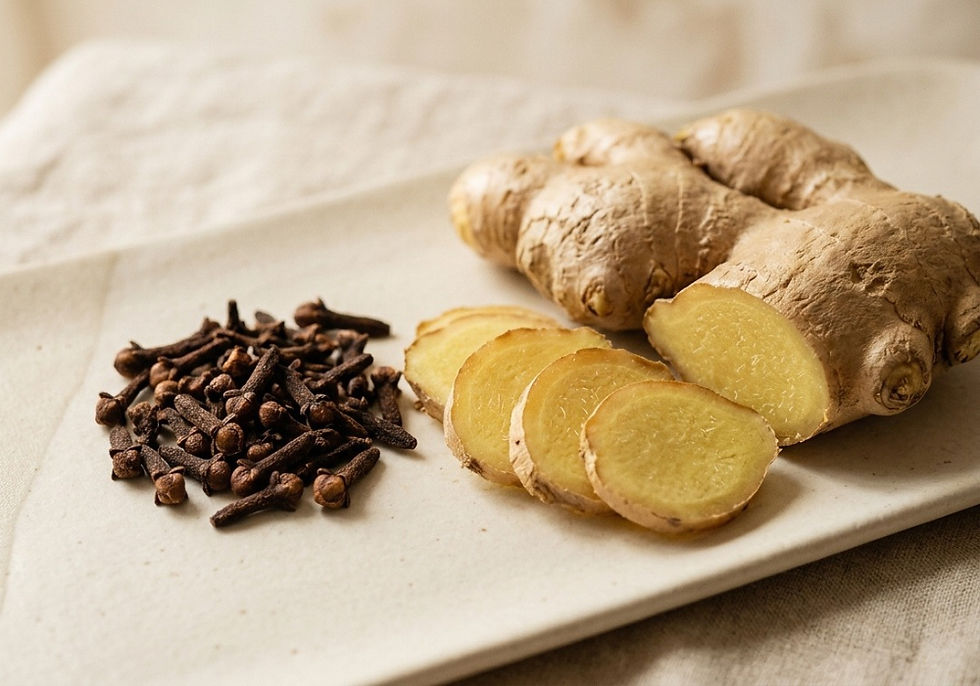
Best Mix: Clove with Cinnamon, Turmeric, Ginger, cardamom, garlic, and black pepper
Updated: Sep 25
Direct answer: A clove-led mix with Ceylon cinnamon, turmeric, ginger, cardamom, garlic, and black pepper brings together seven traditional culinary spices in one blend. These spices are commonly used in foods, teas, and traditional wellness routines, particularly around meals. For concentrated supplements, follow the serving directions on the product label and consider potential interact ions with medications or individual health conditions. Dietary supplements are not a substitute for medical care.
Spices have been treasured not only for flavor but also for their potential health benefits. Combining them brings together different flavors and naturally occurring plant compounds in one blend. At the center of this blend is clove, paired with Ceylon cinnamon, turmeric, ginger, cardamom, garlic, and black pepper.
This seven-spice mix is a practical way to bring several traditional culinary botanicals together in one routine. Capsule blends have also become a convenient option when brewing seven spices every day is not realistic.

Why Clove Takes the Lead
Cloves are among the richest dietary sources of antioxidants, primarily due to eugenol. Eugenol has been studied for antioxidant, antimicrobial, and other biological properties. In a blend, clove is both the flavor anchor and the compound-dense base the other spices sit on.
Ceylon Cinnamon: What research looks at
Ceylon cinnamon, often called “true cinnamon”, generally contains much less coumarin than common Cassia cinnamon. This difference can be relevant when cinnamon is consumed regularly. Cinnamon has also been studied for glucose-related markers, although results remain mixed and current evidence does not establish it as a treatment for diabetes. When paired with clove, the two spices bring together complementary flavors and different naturally occurring plant compounds — not a promise of glucose control.
Turmeric Curcumin: What Research Shows
Turmeric’s best-known compound is curcumin, which has been studied in relation to inflammatory pathways and joint comfort. Combining turmeric with clove puts two antioxidant-rich spices in the same mix. Curcumin is poorly absorbed on its own, which is one reason black pepper often appears in turmeric-containing blends.
Ginger Root: Digestive research
Ginger contains naturally occurring gingerols and shogaols and has been widely studied for digestive-related uses. Human research has examined ginger for several types of nausea and vomiting, although evidence varies depending on the specific use. Together with clove, ginger creates a warm, aromatic combination commonly used in teas and traditional spice preparations.
Cardamom: Gut Comfort and Fresh Breath
Cardamom is traditionally valued after meals for its fresh, aromatic flavor. Human research has also investigated cardamom in relation to cardiometabolic and inflammatory biomarkers, although more research is needed. Paired with clove, it softens clove’s intensity and adds a gut-and-breath layer.
Garlic Bulb: Cardiovascular Research
Garlic is one of the most studied culinary botanicals for cardiovascular markers. Organosulfur compounds, including those related to allicin, are the usual focus. In cooking and in blends, garlic is often paired with clove.
Black Pepper and Curcumin Absorption
Black pepper is in this mix mainly for piperine. Piperine has been studied for its potential to influence curcumin bioavailability. Results vary by dose and formulation, so it is more accurate to say piperine may affect how curcumin is handled than to say it always raises absorption substantially.
What Researchers Study About These Ingredients
Digestive research: ginger is among the better-studied ingredients for nausea and digestive comfort.
Metabolic research: cinnamon has been investigated for glucose-related markers.
Joint-related research: turmeric/curcumin has been extensively studied, with results depending on formulation and population.
Cardiovascular research: garlic has been studied for cholesterol and blood-pressure markers.
Bioavailability research: piperine has been studied alongside curcumin.
Tea, cooking, or capsules?
Format | Best for | Trade-off |
Tea/infusion | After meals, hydration, cold-weather ritual | Dose varies with steep time and whole vs ground spice |
Cooking | Daily food, holiday dishes, family meals | Easy to under- or over-season; heat changes some volatiles |
Capsule blend | Consistent daily amount, no strong taste, travel | Not a culinary experience; follow label and medical advice |
There is no single format that is universally “better.”
Tea and cooking keep these botanicals within a traditional food context, while capsules may be more convenient for people who do not want to measure several spices every day.
Capsule Blends: A Convenient Option
Not everyone will simmer clove, cinnamon, turmeric, ginger, cardamom, garlic, and pepper every day. A capsule that follows the same seven-spice logic is the practical alternative.
Why capsules can help
Consistency: a set serving instead of a pinch that changes by recipe.
Convenience: one step with a meal.
Taste-free: Ideal for those sensitive to strong spice flavors.
If you want that structure in a single daily serving, look for a clove-forward formula that still includes Ceylon cinnamon (not high-coumarin Cassia), turmeric, ginger, cardamom, garlic, and black pepper. Herbpy 7-in-1 Cloves Supplements is built on that map: 500 mg clove bud powder as the lead ingredient, with extracts of the supporting spices and a small amount of black pepper, 755 mg per serving, in a once-daily vegan capsule. Take it with food and a full glass of water. Treat it as a wellness habit, not a medicine.
When and how to use
Supplements: follow the product label. Taking concentrated spices with food may be more comfortable for people with sensitive stomachs.
Kitchen use: use cloves and the rest of the mix in normal culinary amounts.
Hydration: swallow capsules with a full glass of water.
Safety Considerations
General safety
Culinary amounts are appropriate for most healthy adults. Capsule blends should stay on the labeled serving. More is not better with eugenol-rich spices.
Who should be cautious?
Pregnant or breastfeeding women: Safe in food use, but concentrated forms should be avoided unless cleared by a doctor.
People on medication: Especially blood thinners, blood pressure drugs, or diabetes medications—consult a healthcare provider first.
Sensitive stomachs: High doses of spices may cause heartburn or discomfort.
Surgery: If you are preparing for surgery, tell your healthcare provider about any botanical supplements you use and follow their instructions on when to stop them.
Frequently Asked Questions
Can you mix clove, cinnamon, turmeric, and ginger together?
Yes. These spices are commonly combined in foods, teas, curries, and other traditional spice preparations. Their use together does not mean the combination has been clinically proven to prevent or treat a health condition.
Can you take clove and cinnamon together every day?
They are commonly consumed together in normal culinary amounts. Concentrated supplements are different and should be used according to the product label and individual health considerations.
Is Ceylon cinnamon different from Cassia cinnamon?
Yes. They come from different Cinnamomum species and have different chemical profiles.
Ceylon cinnamon generally contains much less coumarin than Cassia cinnamon.
Why is black pepper included with turmeric?
Black pepper contains piperine, which has been studied for its potential influence on curcumin bioavailability.
The effect varies depending on dose and formulation, so it is more accurate to say that piperine may influence curcumin absorption rather than claiming that it always dramatically increases it.
Is tea better than a capsule?
Neither format is universally better.
Tea and cooking provide a traditional culinary way to use spices, while capsules offer convenience and a pre-measured serving.
Key takeaways
This is a clove-led kitchen mix of seven widely studied spices, not a clinically proven seven-in-one treatment.
Most research is ingredient-level or pair-level. Evidence for this exact formula is limited.
Ceylon cinnamon is the lower-coumarin choice when cinnamon is used regularly.
Piperine has been studied with curcumin; results depend on the formula.
Tea, cooking, and capsules are different formats for the same botanicals. Use culinary amounts in food; use labeled servings for capsules.
Clove with cinnamon, turmeric, ginger, cardamom, garlic, and black pepper is a compact way to keep seven familiar kitchen spices in one routine. Cooking and tea keep the food context. A labeled capsule is an option when you want a consistent serving. Used in ordinary amounts and with medical guidance when needed, the mix belongs in the kitchen first.
References
National Center for Complementary and Integrative Health (NCCIH). Cinnamon: Usefulness and Safety.
National Center for Complementary and Integrative Health (NCCIH). Turmeric: Usefulness and Safety.
National Center for Complementary and Integrative Health (NCCIH). Ginger: Usefulness and Safety.
National Center for Complementary and Integrative Health (NCCIH). Garlic: Usefulness and Safety.
Tavvabi-Kashani N, Hasanpour M, Baradaran Rahimi V, Vahdati-Mashhadian N, Askari VR. Pharmacodynamic, pharmacokinetic, toxicity, and recent advances in Eugenol's potential benefits against natural and chemical noxious agents: A mechanistic review. Toxicon. 2024;238:107607. DOI: 10.1016/j.toxicon.2024.107607.
Zhang X, Wang C, Min R, et al. Cardamom consumption may improve cardiovascular metabolic biomarkers in adults: A systematic review and meta-analysis of randomized controlled trials. Nutrition Research. 2024;125:101–112. DOI: 10.1016/j.nutres.2024.03.002.
Shoba G, Joy D, Joseph T, et al. Influence of piperine on the pharmacokinetics of curcumin in animals and human volunteers. Planta Medica. 1998;64(4):353–356. DOI: 10.1055/s-2006-957450.
Kroon MAGM, van Laarhoven HWM, Swart EL, van Tellingen O, Kemper EM. A pharmacokinetic study and critical reappraisal of curcumin formulations enhancing bioavailability. iScience. 2025;28(6):112575. DOI: 10.1016/j.isci.2025.112575.